DIY Front Door Wreath: Choosing the Size and Building It to Fit
Measure the door, pick a finished width and a base to match, check the depth for a storm door, then build a simple faux greenery wreath on an 18 in (46 cm) wire frame.

Tutorial at a glance
Materials
- 18 in (46 cm) wire frame
- About 8 to 10 faux greenery stems
- Green paddle wire
- Wire cutters
- Ribbon or wire for a hanging loop
A DIY front door wreath goes wrong more often at the measuring stage than at the making stage. A wreath that looked generous on the work table can look lost on a wide door, and one that looked modest can crowd the handle or stop a storm door from closing. Both problems are solved before you cut a single stem.
Sizing comes first here: finished width, base size and depth. A plain faux greenery wreath on an 18 in (46 cm) wire frame follows as a worked example.
Measure the Door First
Measure the width of the door slab itself, not the frame around it. Then note anything on the face of the door, such as a knocker, a peephole or a window, that the wreath needs to clear.
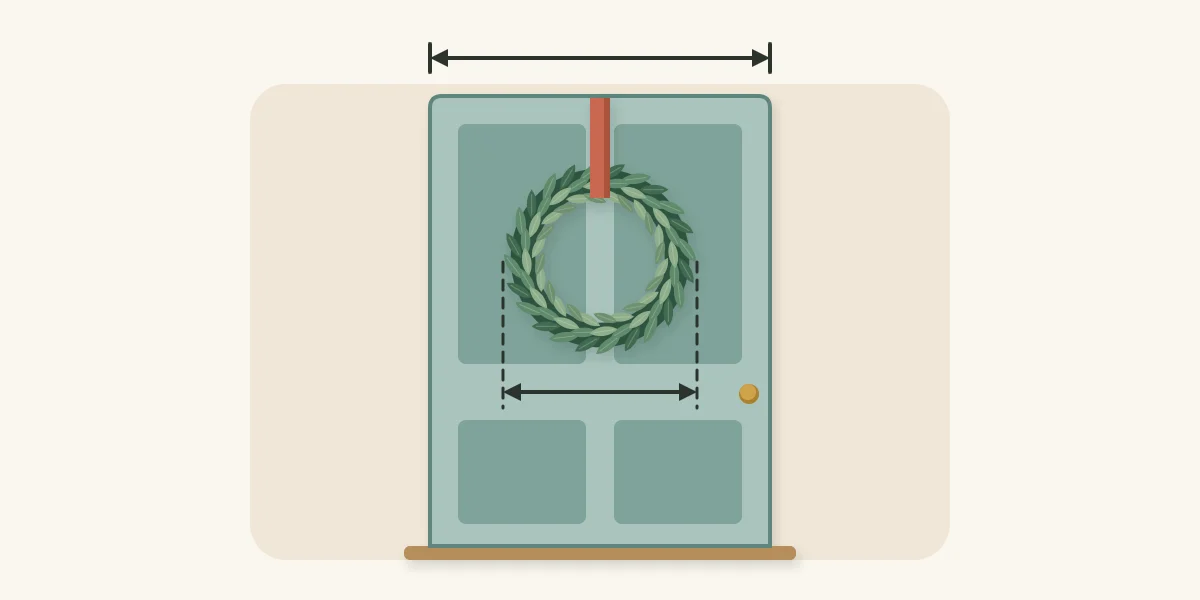
A useful guideline is a finished wreath between about half and two thirds of the door width. That leaves a clear margin on each side, so the wreath reads as centered instead of squeezed in. It is a starting point, not a rule: a plain flat door can carry something closer to the two thirds mark.
| Door width | Finished wreath width | Base to start from |
|---|---|---|
| 30 in (76 cm) | About 15 to 20 in (38 to 51 cm) | 12 to 14 in (30 to 36 cm) |
| 32 in (81 cm) | About 16 to 21 in (41 to 53 cm) | 14 in (36 cm) |
| 36 in (91 cm) | About 18 to 24 in (46 to 61 cm) | 16 to 18 in (41 to 46 cm) |
Before you buy anything, cut a circle of scrap paper or cardboard to the width you are considering and tape it to the door. Step back and look.
Base Size Is Not Finished Size
Wreath bases are sold by the diameter of the bare ring. The finished wreath is always wider, because leaves and stems reach past the frame on the outside and close up the hole on the inside. Leafy faux greenery usually adds a couple of inches on every side, and long stems add more.
So choose the base by working backward. Decide the finished width, subtract what your material will add on both sides, and buy the base nearest to that. For the worked example below, an 18 in (46 cm) wire frame with leaves reaching about 2.5 in (6 cm) beyond it finishes at roughly 23 in (58 cm), which suits a 36 in (91 cm) door. If you are unsure which kind of ring suits your material, the guide to wreath bases compared explains what each one holds well.

Check the Depth for a Storm Door
If a storm or screen door closes over the front door, depth matters as much as width. Open the storm door, hold a ruler flat against the main door, close the storm door gently and read the gap. The wreath, including its thickest flower or bow, has to be thinner than that gap, with a little room to spare so nothing is crushed.
To keep a wreath shallow, use a flat wire frame, lay stems along the ring and skip tall focal pieces.
What You Need
- One 18 in (46 cm) wire frame with concentric rings
- About 8 to 10 faux greenery stems or bushes, in two leaf shapes if you like
- Paddle wire in green
- Wire cutters
- Ribbon or a short length of wire for a hanging loop
Build the Wreath
- Cut the stems down. Snip each faux stem into pieces about 7 in (18 cm) long with wire cutters. Short pieces follow the curve of the ring.
- Make bundles. Gather two or three pieces into a small bundle with the cut ends together. Aim for bundles of similar fullness so the ring stays even.
- Anchor the wire. Twist the end of the paddle wire around a crossbar of the wire frame. Do not cut it from the paddle.
- Bind the first bundle. Lay it on the frame, tips angled slightly outward, and wrap the wire tightly around the stems and frame three times.
- Overlap the next bundle. Place it so its leaves cover the bound stems of the first, and bind again. Alternate bundles toward the outer and inner edge so both are covered.
- Close the circle. Lift the leaves of the first bundle and tuck the last stems underneath. Cut the wire, twist it off at the back and bend the sharp end into the frame.
- Add the hanging loop at the top of the back, on the outer ring.
Tip
Hold the half-finished wreath against the door before you close the circle. If it already looks too wide, shorten the remaining pieces and trim the tips of the bundles you have bound.
Covered and Exposed Doors
A door under a deep porch is the kindest place for any wreath. On an exposed door, sun, rain, wind and humidity change every material. Faux leaves can lose color and stiffness, ribbon can droop, wire can rust, and natural materials dry out, shed or soften.
If your door gets direct sun or driving rain, bring the wreath in during rough weather and expect to refresh it. One practical approach is to keep the greenery ring neutral and change only a small accent, as described in the guide to swappable seasonal decorations.
Hanging It
Hang the wreath so its center sits at about eye level, or centered on the upper panels if the door has them. A wreath on an 18 in (46 cm) frame has some weight, so check the maker’s weight rating and surface instructions for any hook or hanger you use. The options for doors of different materials are set out in the guide to hanging a wreath without nails.
Watch out
Keep the wreath clear of porch lights, lanterns and candles, and check that no wire end at the back can scratch the door.
Common Problems
- Looks too small on the door. Add a round of longer pieces on the outer edge only. This widens the wreath without adding depth.
- Looks too big. Trim the outer tips back toward the frame, working around the ring so it stays round.
- Storm door will not close. Press standing stems flat and rebind them, or move a bow from the front to the lower edge.
When the wreath comes down, keep it flat in a box so it holds its shape; the guide to storing wreaths covers containers for each material.
Frequently asked questions
What size wreath suits a 36 inch front door?
As a guideline, a finished width of about 18 to 24 in (46 to 61 cm) suits a 36 in (91 cm) door, which is roughly half to two thirds of the door width. Start from a 16 to 18 in (41 to 46 cm) base, because the material adds width beyond the frame. Tape a paper circle to the door to check before you commit.
How can a wreath fit behind a storm door?
Measure the gap between the main door and the closed storm door, then keep the wreath thinner than that gap at its thickest point. A flat wire frame, stems laid along the ring and no tall focal pieces all help. Measure the finished wreath lying on a table, from the surface to its highest point.
Can a faux greenery wreath stay on an exposed door?
It can hang there, but sun, rain, wind and humidity change faux materials too, so color and shape may not stay the same. A covered porch is the kinder spot. On an exposed door, bring the wreath in during rough weather and expect to refresh it now and then.