Wreath Bases Compared: Wire, Grapevine, Foam, Straw and Hoops
The five common wreath bases, what attaches well to each one, how much of the ring shows and how the finished width grows beyond the base size.
Tutorial at a glance
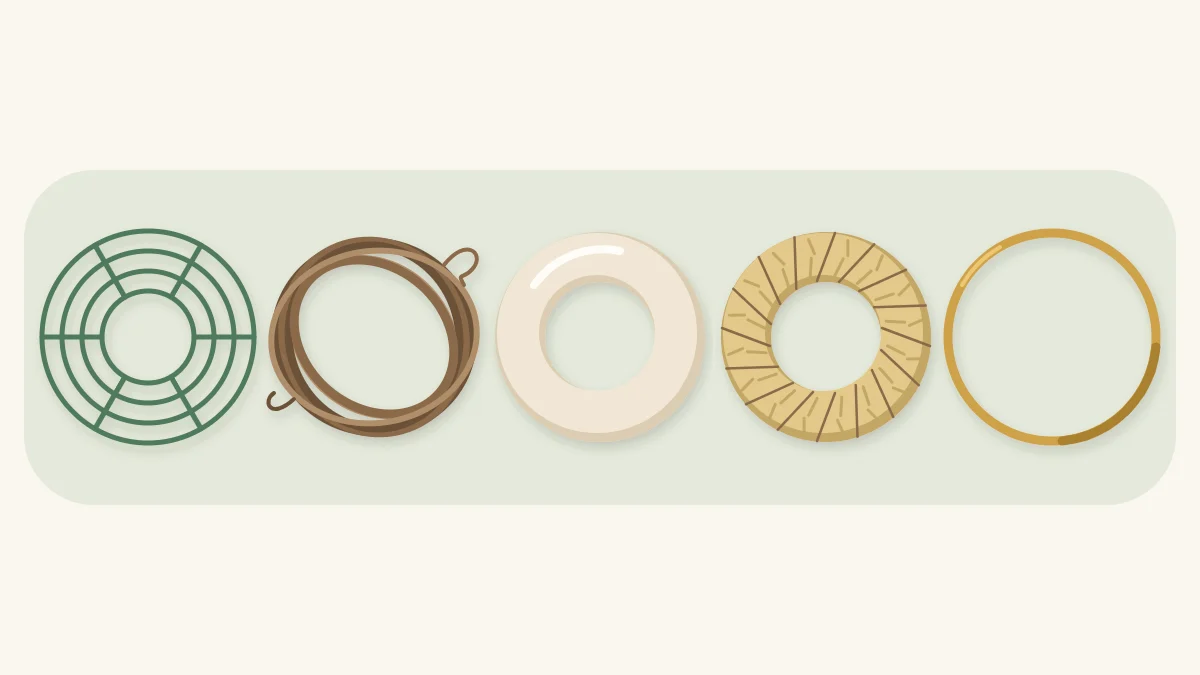
Wreath bases come in five common kinds: the wire frame, the grapevine base, the foam ring, the straw ring and the hoop. They are not interchangeable. Each one holds material in a different way, and a method that works well on one will fail on another.
Choosing the base is the first real decision in any wreath. It settles how you attach things, how much material you need and whether the ring itself becomes part of the design or has to be hidden completely.
Wreath Bases Compared
| Base | Best attachment | Shows through? | Suits |
|---|---|---|---|
| Wire frame | Tying, binding with paddle wire | Yes, must be covered | Ribbon, fabric strips, greenery bundles |
| Grapevine base | Tucking stems, wire, a dot of glue | Yes, and meant to | Faux flowers, branches, partial designs |
| Foam ring | Floral pins, glue, wrapping | Yes, wrap or cover it | Yarn, moss, flower heads |
| Straw ring | Floral pins, wrapped wire | Yes, rustic if left bare | Moss, dried material, greenery |
| Hoop | Wire, floral tape, twine | Yes, left mostly bare | Small sprays, dried flowers |
Wire Frame
A wire frame is a flat ring of welded wire. The most common type is the box frame, with three or four concentric rings joined by cross wires and a slight dish shape. The open rings give you something to tie around and to bind against.
What attaches well: ribbon and fabric strips knotted around a ring, and bundles of greenery bound on with paddle wire. What does not: pins have nothing to grip, and glue has almost no surface to stick to.
The frame is not attractive, so it needs full coverage from the front: tightly packed knots or overlapping bundles.
Grapevine Base
A grapevine base is a ring of dried vines twisted together. Its surface is uneven and full of gaps, and those gaps are the attachment system: a stem pushed in between the vines at a shallow angle, following the twist, is gripped by the vines themselves. A wrap of wire or a small dot of glue makes it secure.
This is the one base that looks good bare, so it suits designs that cover only part of the ring. It is a poor match for anything that needs a smooth surface, such as yarn wrapping or tied strips, because the strands snag and the outline stays lumpy.
Grapevine bases vary a lot in thickness. A thin ring of a few vines suits a light spray, and a thick ring carries heavier flowers and cones. You can also make a grapevine base from fresh vines and choose the thickness yourself.
Foam Ring
A foam ring is light, smooth and even. It comes with a rounded or a flat-backed profile, and the flat back sits closer to a door or wall. Foam takes floral pins, wired picks and glue, and its even surface makes it the natural choice for wrapping, as in a yarn-wrapped wreath.
Foam has two weaknesses. Bare foam shows through any gap, so most projects start by wrapping the ring in ribbon, fabric or yarn in a color close to the decoration. And foam dents and crumbles: thick wire can cut into it, and a pin pushed into the same hole several times stops holding. Some foams soften or melt under very hot glue, so test a small dot on the back first and follow the product label.
Straw Ring
A straw ring is tightly packed straw bound with thread or mesh. It is heavier and firmer than foam and holds floral pins very well, so it is a traditional base for pinned moss and for greenery pinned on in overlapping rows. A moss wreath made with sheet moss works on either straw or foam.
Straw is thick, so the finished wreath has a plump, rounded profile. It sheds bits of straw while you work, so cover the table. Straw absorbs damp, so it belongs indoors or in a dry, covered spot.
Metal or Wooden Hoop
A hoop is a single thin ring of metal or wood. It is a different idea from the other four bases: the ring stays visible and becomes part of the design. Decoration usually covers a third to a half of the hoop.
Because the ring is so thin, there is nothing to pin into or tuck under. Stems are bound on with fine floral wire, floral tape or twine, and a narrow wrap of ribbon hides the binding. Smooth metal is slippery, so a few turns of floral tape on the hoop first give the wire something to grip. Hoops suit light materials. Heavy flowers or cones will make the decorated side swing to the bottom.

Common Sizes and How the Finished Width Grows
The size on a label is the base size, measured across the outside of the bare ring. The finished size is always larger, because material sticks out beyond the base on every side.
- 8 to 10 in (20 to 25 cm): small indoor wreaths, hoops, wall groupings.
- 12 to 14 in (30 to 36 cm): the usual size for a first wreath and for most interior doors.
- 16 to 18 in (41 to 46 cm): a fuller wreath for a wide front door.
How much the width grows depends on the material. Ribbon strips or greenery tips that extend about 2 in (5 cm) past the ring add about 4 in (10 cm) to the total, so a 12 in (30 cm) frame gives a finished wreath of about 16 in (41 cm). Long, loose greenery adds more. A wrapped foam ring or a hoop with a small spray stays close to its base size.
The inner opening shrinks at the same time, so pick a larger base if you want a clear ring shape with bulky material.
Tip
Measure the space first and work backward. Decide the finished width you want, subtract what the material will add on both sides, and buy the base size that is left.
Choosing by Method
If you already know how you want to build, the base follows:
- Tying strips: wire frame.
- Binding bundles of greenery: wire frame, or a hoop for a light design.
- Tucking faux stems and branches: grapevine base.
- Wrapping, pinning or gluing: foam ring, or straw for pinned moss and greenery.
Each method has its own tricks for holding firm. The guide to attaching materials to a wreath covers wire, glue, picks and pins in detail.
Frequently asked questions
Which wreath base is best for beginners?
A wire frame is a good first base because tied ribbon or fabric strips need no other tools and can be moved if they sit in the wrong place. A grapevine base is also beginner-friendly, since stems tuck between the vines and the ring looks finished even when it is only partly covered.
How much bigger is a finished wreath than its base?
It depends on how far the material extends past the ring. Material that sticks out about 2 in (5 cm) on every side adds about 4 in (10 cm) to the width, so a 12 in (30 cm) base gives a wreath of about 16 in (41 cm). Wrapped rings and hoops with a small spray stay close to the base size.
Can floral pins be used on a wire frame?
No. Floral pins need something solid to push into, such as foam or straw. On a wire frame, tie the material on or bind it with paddle wire.