Fall Leaf Wreath with Faux Leaves and Wheat
Layer faux leaves in three warm colors like shingles over two thirds of a grapevine base, then add three wired wheat bundles and a few berries.

Tutorial at a glance
Materials
- Grapevine base, about 14 in (36 cm)
- About 30 to 40 faux fall leaves in terracotta, mustard and plum
- About 15 stems of dried or faux wheat
- A few small faux berry sprigs or seed pods
- Paddle wire or fine floral wire
- Wire cutters and scissors
- Hot glue gun and glue sticks
- Burlap or cotton fabric strip for a bow (optional)
This fall leaf wreath covers about two thirds of a grapevine base with faux leaves in three warm colors, then adds three small bundles of wheat and a scattering of berries. The remaining third stays bare, so the dark vine frames the color.
Two techniques carry the whole project. Leaves are layered like shingles on a roof, each one covering the stem of the one before, and wheat is wired into bundles before it goes anywhere near the wreath.
What You Need
- Grapevine base, about 14 in (36 cm) across
- Faux fall leaves in three colors, such as terracotta, mustard and plum: about 30 to 40 single leaves, or enough to cover two thirds of the ring
- About 15 stems of dried or faux wheat
- A few small faux berry sprigs or seed pods for filler
- Paddle wire or fine floral wire
- Wire cutters and scissors
- Hot glue gun and glue sticks
- Optional: a strip of burlap or cotton fabric for a bow
If your leaves come on garlands or bushy stems, snip them into single leaves, keeping about 1 in (2.5 cm) of stem on each, and sort them by color.
| Material | Role | Attach with |
|---|---|---|
| Faux leaves, three colors | Main cover | Tucked stem and a dot of glue |
| Wheat bundles of five stems | Texture and line | Their own wire tails |
| Berries or seed pods | Filler | Tucked stem, glue if loose |
| Fabric bow | Optional accent | Wire |
Wire the Wheat Bundles First
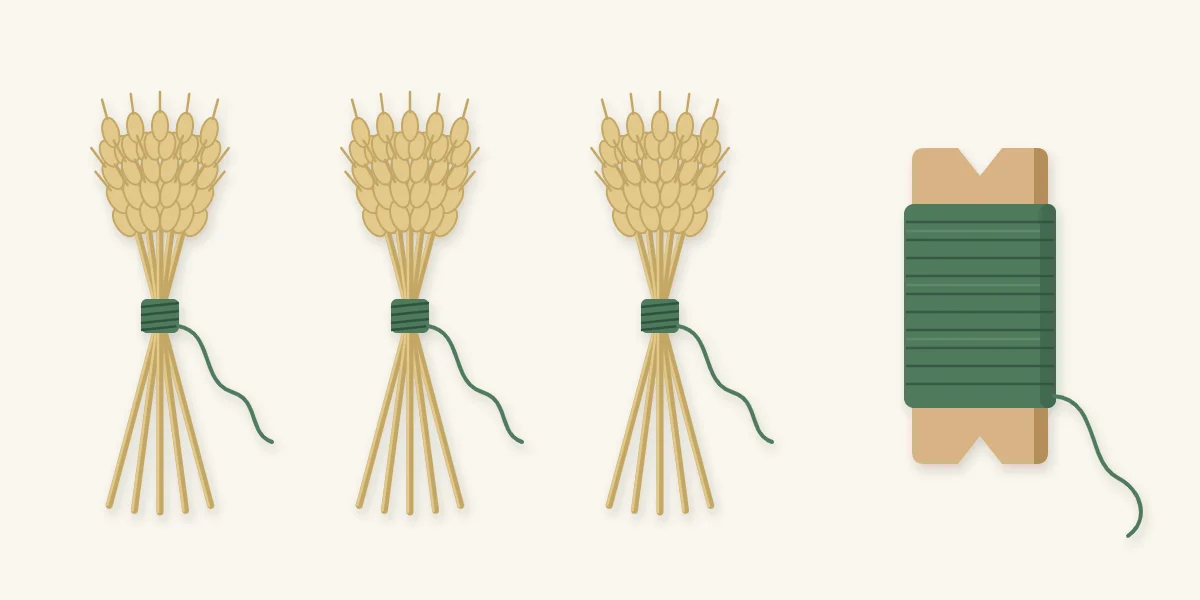
Loose wheat stalks slide out of a wreath one by one. Bound together, they behave like a single stem with its own fastener.
- Count out five stems of wheat and line up the heads so they sit at slightly different heights.
- Trim the stalks so the whole bundle is about 9 in (23 cm) long.
- Wrap paddle wire around the middle of the bundle three or four times, pulling it snug without crushing the stalks. Dried wheat is brittle, and too much force snaps it.
- Cut the wire, leaving a tail about 4 in (10 cm) long. That tail is what ties the bundle to the vine.
- Repeat to make three bundles.
Dried wheat sheds grain and chaff, so work over a tray. Faux wheat is wired the same way.
Map the Two Thirds
Lay the base flat with its best side up and decide where the top is. The bare section in this design sits at the top right, so the leaves start just right of the top center and run the long way around: down the left side, across the bottom and partway up the right. Mark both ends of the section with two loose twists of wire or two clothespins.
You will begin at the mark on the right side and work back around to the mark at the top. Every leaf tip points back the way you came, toward the first leaf, so the layers overlap cleanly. The beginner method for tucking stems into a grapevine base explains how to follow the twist of the vine.
Layer the Leaves Like Shingles
- At the mark on the right side, tuck the stem of the first leaf between two vines at a shallow slant, with the leaf lying flat along the ring and its tip pointing toward the bare vine, away from the direction you will work.
- Put a dot of hot glue where the stem enters the vine. Glue-gun tips and fresh glue burn, so press the stem down with a pencil or a craft stick rather than a fingertip.
- Take a leaf in the second color and place it so its blade covers the stem of the first, as one shingle covers the top of the last. Tuck and glue its stem.
- Add the third color the same way, then repeat the sequence: terracotta, mustard, plum.
- Angle one leaf slightly toward the outer edge, the next toward the inner edge and the next down the center, so the vine underneath is hidden.
- Continue until you reach the mark at the top. The stem of the very last leaf has nothing to cover it, so push it deep between the vines and hide it with a berry sprig or the bow.
Tip
Faux leaves are often pressed flat. Before you start, pinch each one lengthwise along its center vein and curl the tip slightly, so the layers have some depth.

Add the Wheat, Berries and Bow
Space the three wheat bundles along the covered section: one near each end and one near the middle. Lift a leaf, lay the bundle underneath so the heads fan outward past the edge of the wreath, and pass the wire tail around a vine. Twist it tight at the back and bend the cut end into the base, since cut wire is sharp. Let the leaf fall back over the binding.
Tuck berry sprigs or seed pods into gaps between leaves, mostly near the wheat, and use them sparingly.
A bow is optional. A strip of burlap or torn cotton tied in a simple knot suits the texture, and scraps left over from a rag wreath made from fabric strips are ideal. Wire it on at the top, where the last leaf meets the bare vine.
Common Problems
- Stems show between leaves. The overlap is too short. Slide an extra leaf under the one in front to cover the gap.
- Wheat droops. The binding is too low on the bundle or the tail is loose. Rewire nearer the middle and twist the tail tighter.
- The wreath tilts. The covered side is heavier. Shift the hanging loop toward that side until the bare section sits where you planned.
Hanging and Display
Tie a loop of wire or twine around several vines at the back, in the bare section, and hang the wreath from that. A covered door or an indoor wall is the better home. Sun, rain and wind change faux leaves as well as dried wheat: colors fade, wheat goes soft in damp air, and fabric marks. Keep the wreath away from candles, fireplaces and heaters, and keep berries and loose grain away from young children and pets.
Variations
Swap plum for a deep green to cool the palette. For a smaller project, make a single cluster of leaves and wheat on a pick and use it as the fall accent in the one-base, four-seasons wreath.
Frequently asked questions
How many faux leaves does this wreath need?
About 30 to 40 single leaves is a reasonable estimate for two thirds of a 14 in (36 cm) grapevine base, but leaf size changes the count a lot. Buy a little more than you expect to use and stop when no vine shows through the covered section.
Why wire the wheat before attaching it?
Single stalks have nothing to grip and slip out of the vine one at a time. A bundle bound at the middle holds its fan shape, and the wire tail left over ties it directly to the base. It also means the bundle can be removed later without breaking the stalks.
Can real leaves be used instead of faux ones?
Fresh leaves curl and crumble as they dry, so they are hard to layer neatly and shed when handled. Faux leaves keep their shape while you work and can be pinched and curled to look natural. If you do gather natural material, take it only where you have permission and only from plants you can identify with certainty.