How to Store Wreaths So They Keep Their Shape
Clean the wreath, protect the bow, give it its own box or hanging cover, and keep it somewhere cool, dry and dark. Storage notes for faux, dried, paper, fabric, grapevine and fresh wreaths.

Tutorial at a glance
Materials
- Soft dry paintbrush for dusting
- Tissue paper
- Rigid box a little wider than the wreath, or a coat hanger and clear garment-style cover
- Labels and a marker
Most damage to a handmade wreath happens in the closet, not on the door. Knowing how to store wreaths properly means dealing with three things: weight pressing on the decorations, damp, and light. Get those right and the wreath comes out of storage looking much as it did when it went in.
The routine is the same for nearly every wreath. Clean it, protect the bow, give it a container of its own, and put that container somewhere cool, dry and dark. What changes from one material to the next is how gently you have to handle it and whether it should lie flat or hang.
Clean the Wreath Before It Goes Away
Dust left on a wreath works its way into fabric and petals while it sits. Take the wreath outside or hold it over a tray and remove loose dust first. A soft, dry paintbrush reaches between faux petals and leaves. A hair dryer on its cool, low setting, held well back, shifts dust from ribbon and fabric wreaths. For dried and paper wreaths use the brush only, with the lightest touch.
Do not wash or spray a wreath unless the material’s own label says you can. Water loosens hot glue joins, stains ribbon and softens paper and dried stems. If any part is damp from outdoor use, let the whole wreath air dry fully in a room before packing it, because damp sealed in a box leads to mold and a musty smell.
Check the wreath over while it is in your hands. Reglue anything loose, snip stray glue threads, and bend cut wire ends back into the base so they cannot snag tissue or scratch the next wreath.
Protect the Bow
A bow is the first thing to flatten. There are two ways to deal with it. If the bow is wired on, untwist the wire tails, lift it off and store it separately in a small box. If it is glued or you would rather leave it in place, stuff every loop with a small roll of tissue paper so the loop cannot collapse, and lay the tails flat without folding them.

Flat in a Box or Hanging in a Cover
There are two sound ways to store a wreath, and the right one depends on its shape and how much room you have.
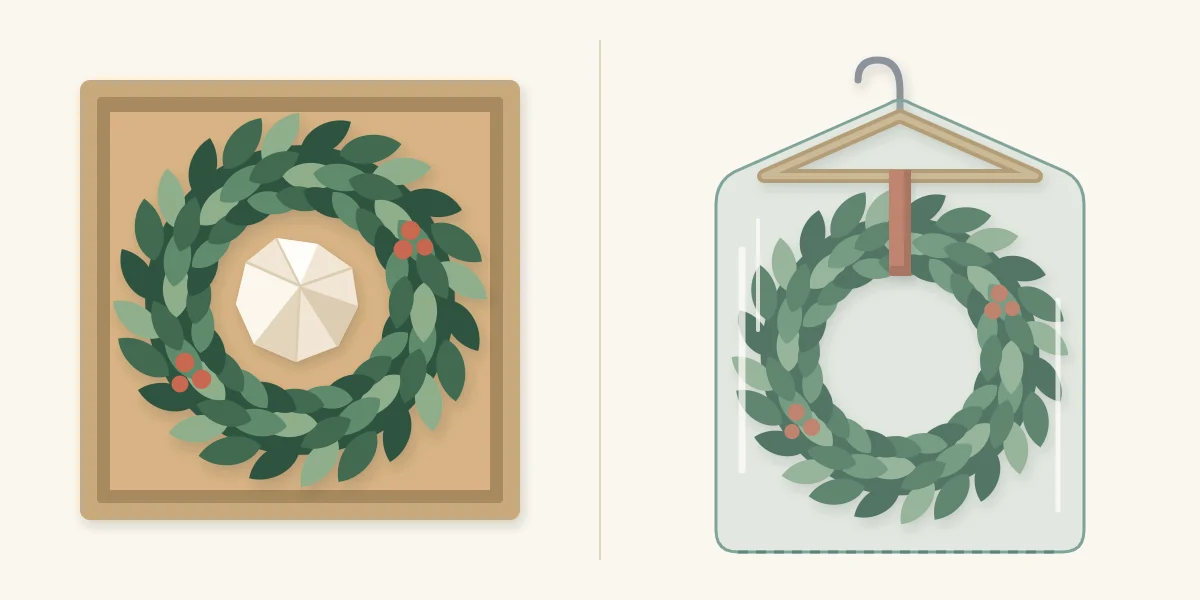
Flat in a box. Lay the wreath face up in a box a little wider than the wreath and at least as deep as its tallest decoration. Crumple tissue paper and set it in the center of the ring so the wreath cannot slide, then tuck more around the outside if there is space. Flat storage suits fragile and three-dimensional wreaths because nothing pulls on the decorations.
Hanging in a cover. Hook the wreath’s hanging loop over a coat hanger, or tie it on with ribbon, and slip a clear garment-style cover over the whole thing. Hang it on a rail with space on both sides. Hanging suits sturdy, flatter wreaths and saves shelf room. It does not suit heavy wreaths whose decorations could sag, or dried flowers, which shed when they swing.
Either way, give each wreath its own container. If two must share a box, separate them with several sheets of tissue and put the lighter one on top.
Tip
Leave the hanging loop on the wreath. It gives you something to lift it by, so you never have to pull on the decorations. The guide on hanging a wreath without nails shows how to add a loop if yours has none.
Storage by Wreath Type
| Wreath type | Container | Watch for |
|---|---|---|
| Faux flowers and greenery | Box, or hanging in a cover | Crushed petals; heat that softens glue |
| Dried flowers and grasses | Rigid box, flat, padded with tissue | Shedding, damp, insects |
| Paper | Rigid box, flat | Damp and anything resting on top |
| Ribbon, fabric and yarn | Box or cover | Dust, moths, flattened strips |
| Grapevine with decorations | Box or cover | Brittle vine ends, damp |
| Fresh greenery | Not stored | Keep only the frame and wire |
Faux
Faux wreaths are the most forgiving. Reshape bent stems before packing rather than after, since wired stems hold whatever position they are stored in.
Dried
Dried material is brittle and sheds with every knock, so move it as little as possible. Lower a dried flower wreath on a hoop into its box by the hoop, never by the stems, and do not seal it in an airtight bag, where any trace of moisture has nowhere to go.
Paper, fabric and yarn
Paper needs a rigid box and nothing on top of it. Fabric, ribbon and yarn wreaths squash without harm and can be fluffed later, but they attract dust and moths, so close the container fully.
Grapevine
A bare grapevine base only needs a dry shelf. A decorated one is stored like a faux wreath, with a little extra care for vine ends that can snap.
Fresh
A fresh evergreen wreath is not stored. When it has dried out, cut the paddle wire, put the plant material in the compost or yard waste, and keep the wire frame for the next one. Wear gloves, because dry needles are sharp.
Where to Keep the Container
Choose a cool, dry, dark place with a steady temperature: an interior closet, a shelf in a spare room, the space under a bed. Attics and garages often swing between hot and cold, and heat can soften hot glue and warp foam, while damp basements encourage mold. Keep boxes off the floor and away from heaters, water pipes and windows. Light fades ribbon, paper and dried flowers even indoors, which is another reason for an opaque box or a dark closet.
Watch out
Careful storage slows wear but does not stop it. Every material changes with age, faux included, so expect to refresh a bow or replace a few stems from time to time.
Label It and Check It
Write the wreath’s name, its size and the season on the outside of the container, and note whether the bow is inside or stored separately. If you use one base with swappable seasonal decorations, the label is what stops the fall accents from disappearing behind the winter ones.
Look in on stored wreaths now and then, especially after a humid spell, and check for damp, insects or a slipped lid.
Frequently asked questions
Is it better to store a wreath flat or hanging?
Flat storage in a box suits fragile, deep or heavily decorated wreaths because nothing pulls on the decorations. Hanging in a cover suits sturdy, flatter wreaths and saves shelf space. Dried flower and paper wreaths are better kept flat in a rigid box.
Can a fresh evergreen wreath be stored for next year?
No. Fresh greenery dries out and sheds, so it is not stored. Cut the wire, compost the plant material and keep the wire frame, which can be used again for a new wreath.
How do I keep a wreath bow from getting crushed in storage?
Either untwist the wire and store the bow separately in a small box, or leave it on and stuff each loop with a small roll of tissue paper. Lay the tails flat without folding them, since creases across a tail are harder to remove than a flattened loop.


