How to Attach Materials to a Wreath: Wire, Glue, Picks and Pins
Five ways to fix material to a wreath base, which base each one suits, how to bind overlapping bundles with paddle wire and how to test the hold.
Tutorial at a glance
Materials
- Paddle wire
- Wire cutters
- Hot glue gun and glue sticks
- Wired picks
- Floral pins
- Ribbon or twine
Knowing how to attach materials to a wreath matters more than any single design. A wreath hangs upright, gets bumped by a closing door and is lifted on and off its hook, so every stem, cone and flower has to stay put against gravity, not just sit nicely on a table.
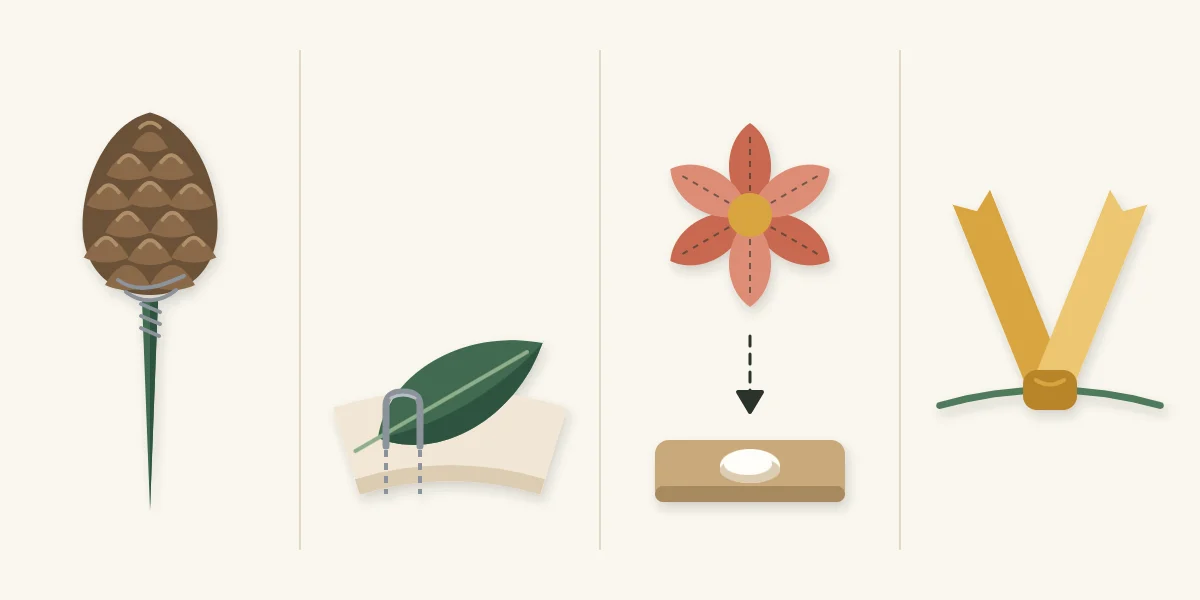
There are five ways to fix material to a wreath base: binding with paddle wire, hot glue, wired picks, floral pins and plain tying. Each one suits certain bases and certain materials.
The Methods at a Glance
| Method | Works on | Removable? |
|---|---|---|
| Binding with paddle wire | Wire frame, hoop, grapevine | Yes, unwind the wire |
| Hot glue | Foam, cardboard, grapevine, felt | No |
| Wired picks | Foam, straw, grapevine | Yes, pull the pick out |
| Floral pins | Foam, straw | Yes, pull the pin out |
| Tying | Wire frame, hoop | Yes, untie the knot |
The base decides most of this for you. If you are not sure what yours can hold, the wreath bases comparison goes through each type. The tools themselves are described in the guide to wreath making supplies.
Binding Bundles with Paddle Wire
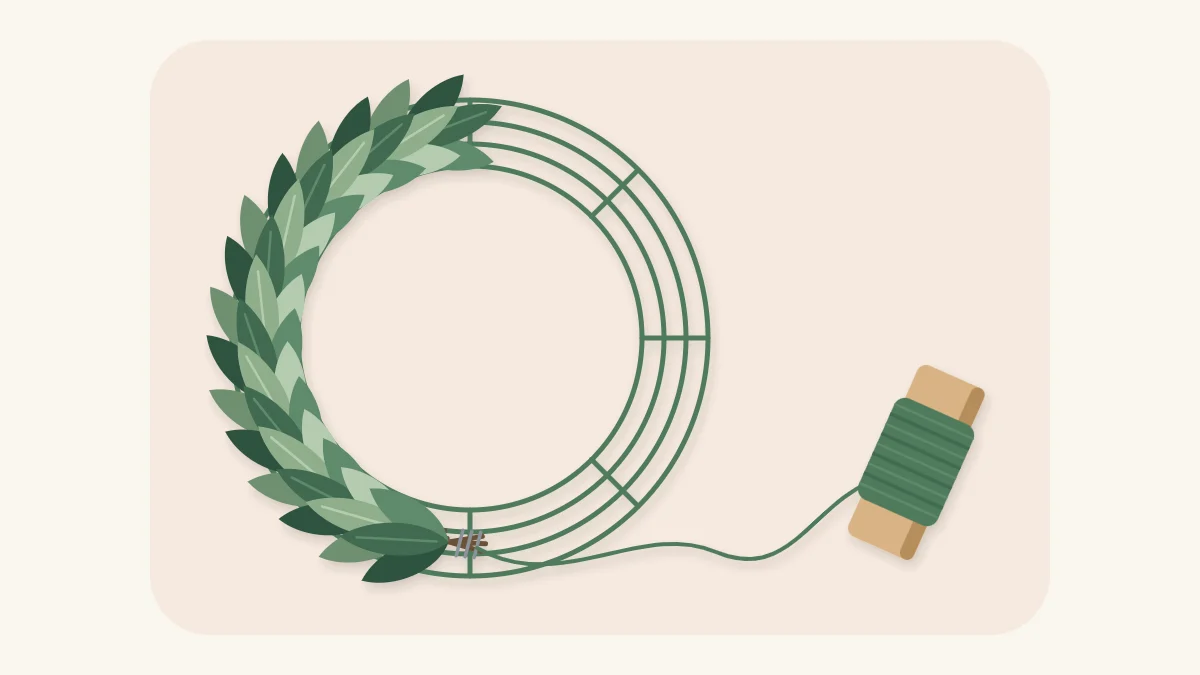
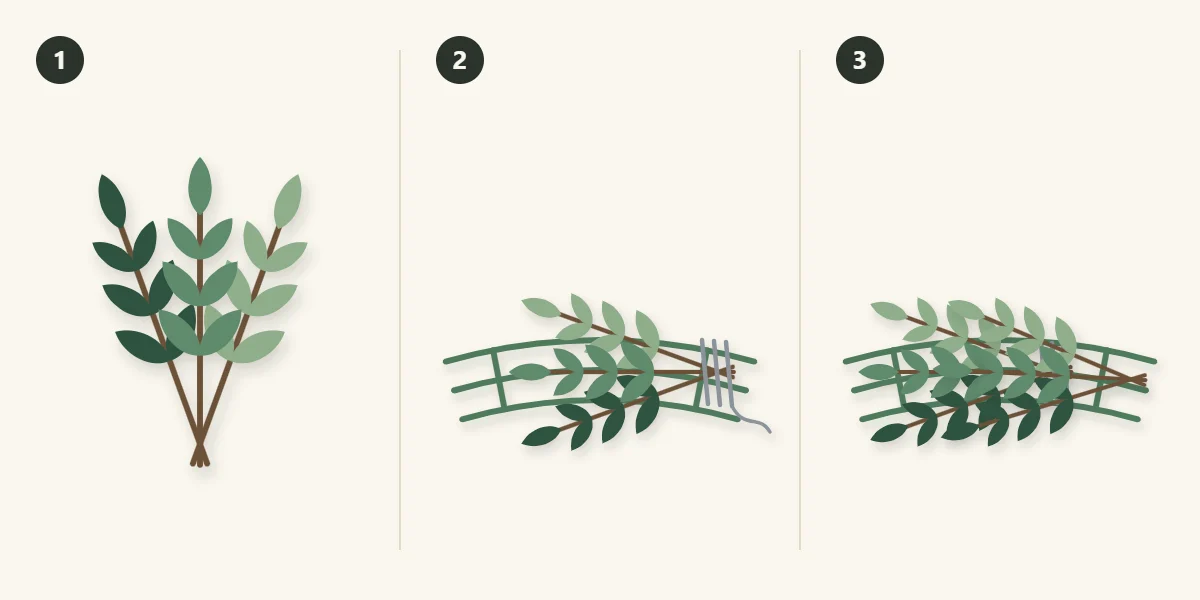
Binding is the standard method for greenery, dried flowers and anything else with a stem. You do not attach stems one at a time. You gather them into small bundles and bind each bundle to the frame, with one continuous wire running all the way around.
- Gather a small bundle. Take three short leafy stems, about 6 in (15 cm) long, and hold them together with the cut ends level. Put the fullest stem at the back and the shorter ones in front. A bundle should be a small handful, not a bouquet. Thick bundles leave lumps and are hard to bind tightly.
- Wire it to the frame. Twist the end of the paddle wire around the frame to anchor it. Lay the bundle on the frame and wrap the wire three times around the stems and the frame together, pulling firmly on each turn. Wrap near the cut ends, not over the leaves. Do not cut the wire.
- Overlap the next bundle. Lay a second bundle over the stems of the first, so its leaves hide the bare ends and the wire. Wrap three times again. Keep going in the same direction around the ring.
If you can see wire or stems from the front, the bundles are too far apart.
When you reach the start, lift the leaves of the first bundle and tuck the stems of the last one underneath. Cut the wire, leaving a tail, twist it around the frame on the back and bend the sharp end into the wreath.
Hot Glue
Hot glue is the fastest way to fix light, dry, flat-bottomed pieces: paper flowers and leaves, felt, cut faux flower heads, small cones and ribbon ends. It works on foam, cardboard rings and grapevine, and poorly on bare metal, where the glue peels away cleanly once it cools.
Use a dot, not a puddle. Put a small amount of glue on the piece or on the base, press the two together and hold until the glue is firm. Too much glue squeezes out at the edges and leaves shiny strings. For setting and handling, follow the product label.
Glue is permanent, so arrange everything dry first and glue only when the layout is settled.
Watch out
The glue and the tip of the gun burn. Press small pieces down with a wooden skewer instead of a finger, rest the gun on its stand over a heatproof mat, and unplug it when you step away.
Wired Picks
A wired pick is a short wooden stick with a length of fine wire attached. It gives a stem to things that do not have one. Wrap the wire tightly around the base of a cone, a seed pod or a small cluster of berries, and the pick becomes a stem that you can push into foam or straw or wedge between the vines of a grapevine base.
Picks are the best choice for heavier accents, because the stick sits deep in the base and takes the weight. Push the pick in at a slant, not straight down, so the piece cannot pull straight out. A dot of glue at the entry point locks it if the wreath will be handled a lot. A pinecone wreath uses the same idea, with a wire tail on every cone.
Floral Pins
Floral pins are U-shaped wires that work like a staple. They hold flat or soft material against a foam or straw base: sheet moss, large leaves, ribbon wraps, the bound end of a bundle. Straddle the material with the two legs and push the pin in until the top sits flush.
Angle neighboring pins in different directions. Pins pushed in at a slant grip much better than pins pushed straight in, which can slide back out under weight.
Tying
Tying needs no tools at all. A strip of ribbon or fabric knotted around a wire ring holds by friction and by the pressure of the strips beside it, which is why tied wreaths are packed so tightly. On a hoop, twine or a narrow ribbon tied around a small spray both holds it and hides the wire underneath.
A ribbon tie is also the neatest way to add something you plan to swap later, such as a bow.
Test the Hold
A wreath that looks secure lying flat can sag the moment it hangs. Test it before you call it finished, and again partway through a large project.
- Lift the wreath upright by the top and hold it at arm’s length.
- Give it a gentle shake. Watch for bundles that swing, flowers that droop forward and anything that drops.
- Tug each large piece lightly. It should not turn or slide.
- Fix what moved: add a turn of wire, a pin or a dot of glue, then test again.
Tip
Finish by running a hand slowly over the back of the wreath. Bend every wire end you can feel back into the base, so nothing scratches the door or your fingers.
Once everything holds, the remaining question is where each piece should go. The guide to balanced wreath composition covers placement, proportion and color.
Frequently asked questions
Is wire or hot glue better for attaching things to a wreath?
Wire is better for anything with a stem and for wreaths you may want to take apart, because it can be unwound. Hot glue suits light, dry, flat-bottomed pieces such as paper, felt and cut flower heads, and it is permanent. Many wreaths use both: wire for the structure and a dot of glue to lock an accent.
Why do the stems on a wired wreath keep slipping?
The bundles are usually too thick or the wire is too loose. Make smaller bundles, wrap the wire three times near the cut ends and pull firmly on each turn. Keeping one continuous wire around the whole ring also helps, because each wrap tightens the one before it.
How long does hot glue need before the wreath can be moved?
That depends on the glue and the gun, so follow the product label. As a practical check, hold each piece until the glue is firm and no longer shifts under light pressure, and let the whole wreath cool before you lift it upright.