Rag Wreath from Fabric Strips: A No-Sew Tied Wreath
Tear or cut cotton fabric into short strips and knot them onto a wire frame, ring by ring, until the metal is hidden under a shaggy ring of cloth.

Tutorial at a glance
Materials
- Wire frame with concentric rings, 12 to 14 in (30 to 36 cm)
- Woven cotton fabric in three or four prints
- Fabric scissors
- Ruler
- Twine or ribbon for the hanging loop
A rag wreath is made by knotting short strips of cotton fabric onto a wire frame until the metal disappears under a shaggy ring of cloth. There is no sewing, no glue and no pattern to follow, which makes it one of the most forgiving wreaths to start with. If a knot sits badly, you untie it and try again.
The method is the same as a tied ribbon wreath on a wire frame, but fabric behaves differently from ribbon. It frays, it has a right and a wrong side, and it grips the wire so the knots stay where you push them.
What You Need
- A wire frame with concentric rings, 12 to 14 in (30 to 36 cm) across
- Woven cotton fabric in three or four prints, new or scrap
- Fabric scissors
- A ruler
- A short length of twine or ribbon for the hanging loop
Light woven cotton, such as quilting cotton or an old shirt, tears cleanly and knots small. Stretchy jersey curls into tubes and heavy canvas makes bulky knots that leave gaps, so save those for other projects. If you are unsure which frame to buy, the comparison of wreath bases explains how a wire frame differs from foam and grapevine.
Choosing and Mixing Prints
Three or four fabrics are enough. A reliable mix is one small print, one stripe or check, one plain color and one light neutral, for example sage with small dots, plain terracotta, a mustard stripe and cream. The plain and the neutral give the eye a rest, and the prints keep the ring from looking flat.
Check the back of each fabric before you commit. Printed cotton is often much paler on the wrong side, and in a tied wreath both sides show. Woven stripes and checks look the same on both faces, which is why they work so well here.
Tearing or Cutting the Strips
Aim for strips about 1 in (2.5 cm) wide and 8 in (20 cm) long. Shorter strips are hard to knot, and much longer ones flop instead of standing out from the frame.
You can tear the strips or cut them, and the choice changes the look of the finished wreath.
| Method | Edge | Look | Best for |
|---|---|---|---|
| Tearing | Soft and frayed | Shaggy, rustic | Woven cotton |
| Scissors | Clean and flat | Neater, sharper | Fabric that will not tear straight |
| Pinking shears | Zigzag | Tidy with less fraying | Loose weaves |
To tear, cut the fabric into a piece 8 in (20 cm) deep first. Along one edge, make a row of short snips about 1 in (2.5 cm) apart, each snip only as long as a fingertip. Grip the fabric on both sides of a snip and pull apart firmly. Woven cotton splits along the thread, so the strip comes off straight without any measuring. Pull away the long loose threads and leave the short fuzz.

How to Tie the Rag Wreath
- Sort the strips. Make one pile per fabric so you can pick them up in a repeating order without thinking about it.
- Start on the innermost ring. Slide a strip under the wire, bring the ends up to equal length and tie a single firm knot on the front of the frame. A second knot is only needed for slippery fabric.
- Push the knot along. Slide it tight against the nearest crossbar or the previous knot. Packed knots force the tails to stand up instead of lying flat.
- Repeat around the ring. Rotate through the prints in the same order, or pick at random if you prefer a scrappier look. Keep every knot facing the front.
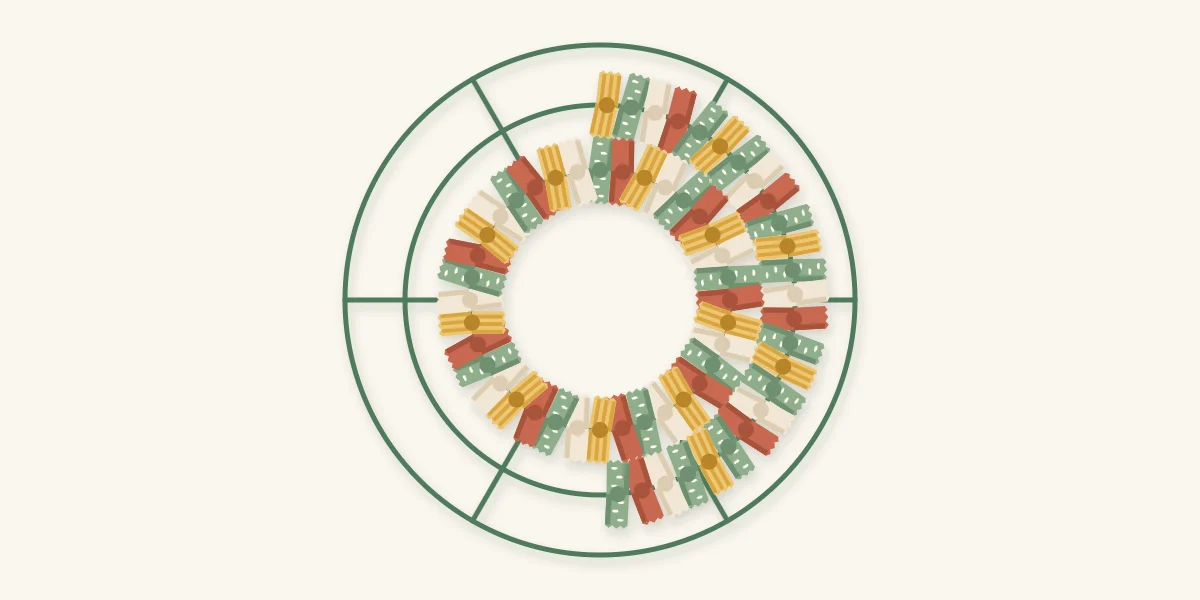
- Move to the next ring. Finish the inner ring completely, then the middle of the frame, then the outer ring. Outer rings are longer, so they take more strips.
- Check the back. Turn the frame over and look for bare wire. Add strips wherever metal shows.
Working ring by ring matters because a finished ring crowds the one beside it. If you tie all the rings at once in one section, that section ends up packed and you cannot judge how many strips the rest of the frame needs. There is no fixed number of strips to count toward: keep tying until the frame is hidden from the front.
Tip
Tie about a hand’s width of one ring, then stop and push every knot together. If a gap opens, the knots were not packed tightly enough, and it is easier to correct now than at the end.
Fluffing and Trimming
Hold the finished wreath upright and shake it gently so loose threads fall away. Then work around the ring with your fingers, pulling tails toward the front, the inside edge and the outside edge so they spread in all directions.
Snip tails that stick out far beyond the others and cut away long dangling threads. A rag wreath is meant to look shaggy, so stop before it looks clipped.
Common Problems
- Wire shows between knots. Slide the knots together and tie extra strips into the space. Thin fabric needs more strips than thick fabric.
- Tails lie flat. The knots are too loose or too far apart. Retie firmly and pack them closer.
- Edges fray into long strings. A very loose weave will keep shedding. Cut those strips with pinking shears, or swap the fabric.
Hanging and Displaying It
Tie a loop of twine or ribbon around the outer ring at the back, hiding the knot among the strips. A fully tied 12 in (30 cm) frame usually ends up about 16 in (41 cm) across, because the tails add width on every side, so measure the finished wreath before you choose its spot.
Cotton takes up moisture and its colors change in strong sun, so a covered door or an indoor wall is the kinder place for it. Keep the wreath well away from candles, fireplaces, heaters and bulbs, and keep loose threads and offcuts away from young children and pets.
Variations
Change the fabrics and the same method gives a different wreath: plaids and deep colors for fall, pale florals for spring, all cream and linen tones for a neutral look. For a softer, smoother ring made from the same kind of leftovers, try a yarn-wrapped wreath on a foam ring.
Frequently asked questions
How many fabric strips does a rag wreath need?
There is no fixed number. It depends on the size of the frame, the weight of the fabric and how tightly the knots are packed. Tie strips until no wire shows from the front, and prepare more in small batches as you go.
Is it better to tear or cut the fabric strips?
Tearing gives a soft frayed edge and a shaggier wreath, and it keeps the strips straight on woven cotton without measuring each one. Cutting with scissors gives a cleaner, flatter edge and is the better choice for fabric that will not tear in a straight line.
Can a rag wreath be made from old clothes?
Yes, as long as the fabric is a light woven cotton such as shirting. Wash and dry it first, cut away seams and hems, and avoid stretchy jersey, which curls into tubes instead of lying as a flat strip.