How to Make a Faux Flower Wreath on a Foam Base
Wrap a 12 in (30 cm) foam ring in ribbon, cut faux flower heads from their stems, then glue large, medium and small flowers in that order until the base is covered.

Tutorial at a glance
Materials
- 12 in (30 cm) foam ring
- Ribbon about 1.5 in (4 cm) wide for wrapping
- About 5 large faux flowers
- About 10 to 12 medium faux flowers
- Small faux flowers and leaves for filler
- Wire cutters
- Hot glue gun, glue sticks and floral pins
- Ribbon or wire for a hanging loop
A faux flower wreath on a foam base is one of the more forgiving floral projects, because every flower is placed one at a time and can be moved until it is glued. There is no bundling and no binding wire. The work is in the preparation and in the order you place things: large flowers first, then medium, then the small pieces that close the gaps.
This version covers a 12 in (30 cm) foam ring completely, front and edges, in three flower sizes and two or three colors. The back stays flat so the wreath sits against a door or wall.
What You Need
- One 12 in (30 cm) foam ring
- Ribbon about 1.5 in (4 cm) wide to wrap the ring, in a color close to your leaves
- About 5 large faux flowers, 3 to 4 in (8 to 10 cm) across
- About 10 to 12 medium faux flowers
- Small faux flowers and leaves, enough to fill the gaps
- Wire cutters
- Hot glue gun and glue sticks, plus floral pins
- Ribbon or wire for a hanging loop
Flower counts are estimates. The number you need depends on how wide and how open each bloom is, so buy a little extra of the small sizes and stop when the base is covered.
Choose Sizes and Colors
Three sizes of flower give the wreath depth. If every bloom is the same size, the surface looks flat. For color, pick two or three flower colors plus the green of the leaves. One color should clearly lead, usually the large flowers, with the others in supporting amounts.
| Size | Role | Placed |
|---|---|---|
| Large | Focal flowers, set the rhythm | First, evenly spaced |
| Medium | Fill the spaces between | Second |
| Small and leaves | Filler for gaps and edges | Last |
The reasons these proportions work are covered in the guide to balanced wreath composition.
Wrap the Base and Sort the Flowers
However closely you pack the flowers, small gaps open between them, and bare foam showing through looks unfinished. Wrapping the ring in ribbon first means any gap shows a quiet color instead.
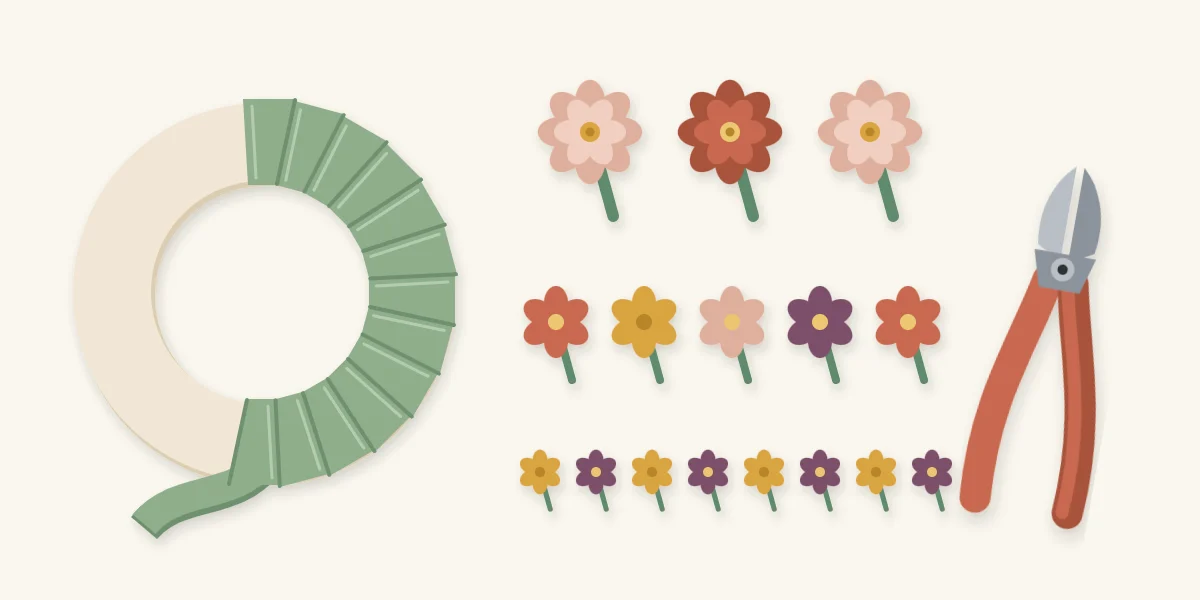
Pin or glue the end of the ribbon to the back of the ring. Wind it around the foam, overlapping each turn by about a third and pulling it snug so it lies flat. Fix the end on the back with a pin or a dot of glue. Some foam softens under very hot glue, so test a dot on the back first or use a low-temperature gun.
Then prepare the flowers. Pull or snip each head from its long stem with wire cutters, leaving a short stub of about 1 in (2.5 cm). The stub pushes into the foam and gives the glue something to grip. Sort the heads into three groups by size, large, medium and small, so you can see what you have before you start placing.
Watch out
Faux stems have a wire core that leaves a sharp end when cut. Snip away from your face, and keep the offcuts, pins and loose petals away from young children and pets.
Place the Flowers from Large to Small
Lay the wrapped ring flat. Set the flowers in place without glue first, look from above, and only then fix them.
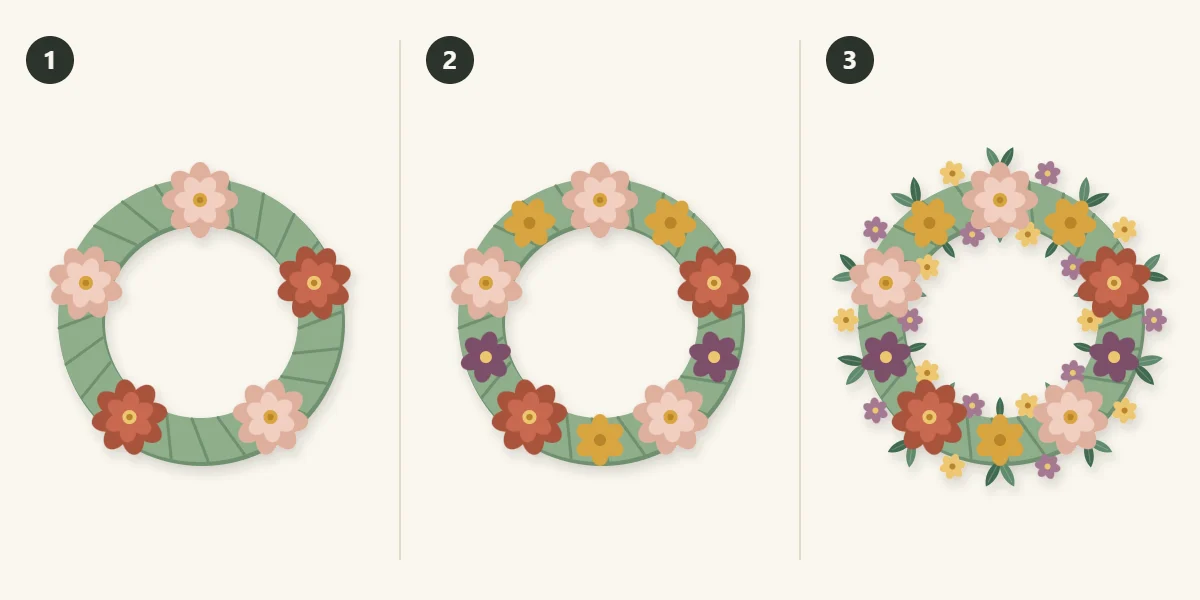
- Large flowers, evenly spaced. Place five large flowers around the front of the ring with roughly equal spaces between them. For each one, poke a small hole in the foam with the stub, add glue to the stub and the base of the flower, and press it in until the glue is firm. Tilt some slightly toward the outer edge and some toward the inner edge so they do not sit in a perfect circle.
- Medium flowers between them. Fill each space between the large flowers with two or three medium ones. Nestle them close, with petals touching or slightly overlapping the large blooms. Alternate the colors as you go.
- Small flowers and leaves last. Work around the ring filling every remaining gap, then cover the inner and outer edges. Leaves are useful here: glue them so their tips peek out from under the flowers along both edges, which hides the side of the ring and frames the blooms.
Stop at the edge of the back. A flat back lets the wreath hang flush and keeps petals from being crushed against the door. For a closer look at when glue, pins or picks suit a job best, see the guide to attaching materials to a wreath.
Tip
Floral pins hold a flower in place while you decide. Pin through the base of the bloom, check the look, then lift it, glue it and press it back.
Check the Coverage
Stand the wreath upright and look at it from the front, then from each side at a low angle. Side views show bare edges that are invisible from above. Press gently on each large flower; anything that wobbles needs more glue at the base or a pin beside the stub.
Pull off glue strings once the glue is cool.
Common Problems
- Flowers pop off. The glue was only on the stub. Add glue under the base of the bloom as well, so it bonds to the ribbon.
- The ring looks lumpy. Large flowers ended up bunched on one side. Before gluing, check the spacing from directly above.
- Ribbon or foam shows at the edges. Add leaves and small flowers along the inner and outer rim, angled outward.
- Colors look blotchy. One color is clustered. Swap a few medium flowers so each color appears all the way around.
Hanging, Storing and Variations
Glue a loop of ribbon to the back, or pin and glue a loop of wire, and let it firm up before the wreath takes any weight. Check the weight rating of your hook. Faux petals can lose color in strong sun and droop in damp air, so a covered door or an indoor wall is the safer choice. Keep the wreath well away from candles, fireplaces and heaters.
Because the petals crush easily, keep the wreath flat in a box with tissue around it between uses; the guide to storing wreaths has more detail. If you like these flowers but want a lighter look with part of the base on show, try the beginner method for decorating a grapevine wreath instead.
Frequently asked questions
Why wrap a foam ring before adding faux flowers?
Small gaps always open between flower heads, and bare foam showing through them looks unfinished. A ribbon wrap in a color close to the leaves makes those gaps hard to notice. It also gives hot glue a surface to bond to.
How many faux flowers does a 12 inch foam wreath need?
There is no fixed number, because it depends on how wide and open each bloom is. As a rough starting point, plan on about five large flowers, ten to twelve medium ones and a generous handful of small flowers and leaves. Buy extra of the small sizes and stop when the base is covered.
Should I glue or pin faux flowers to foam?
Both have a use. Pins are good for holding a flower while you check the arrangement, and glue gives the firmer hold once you are happy. Some foam softens under very hot glue, so test a dot on the back of the ring or use a low-temperature gun.

